
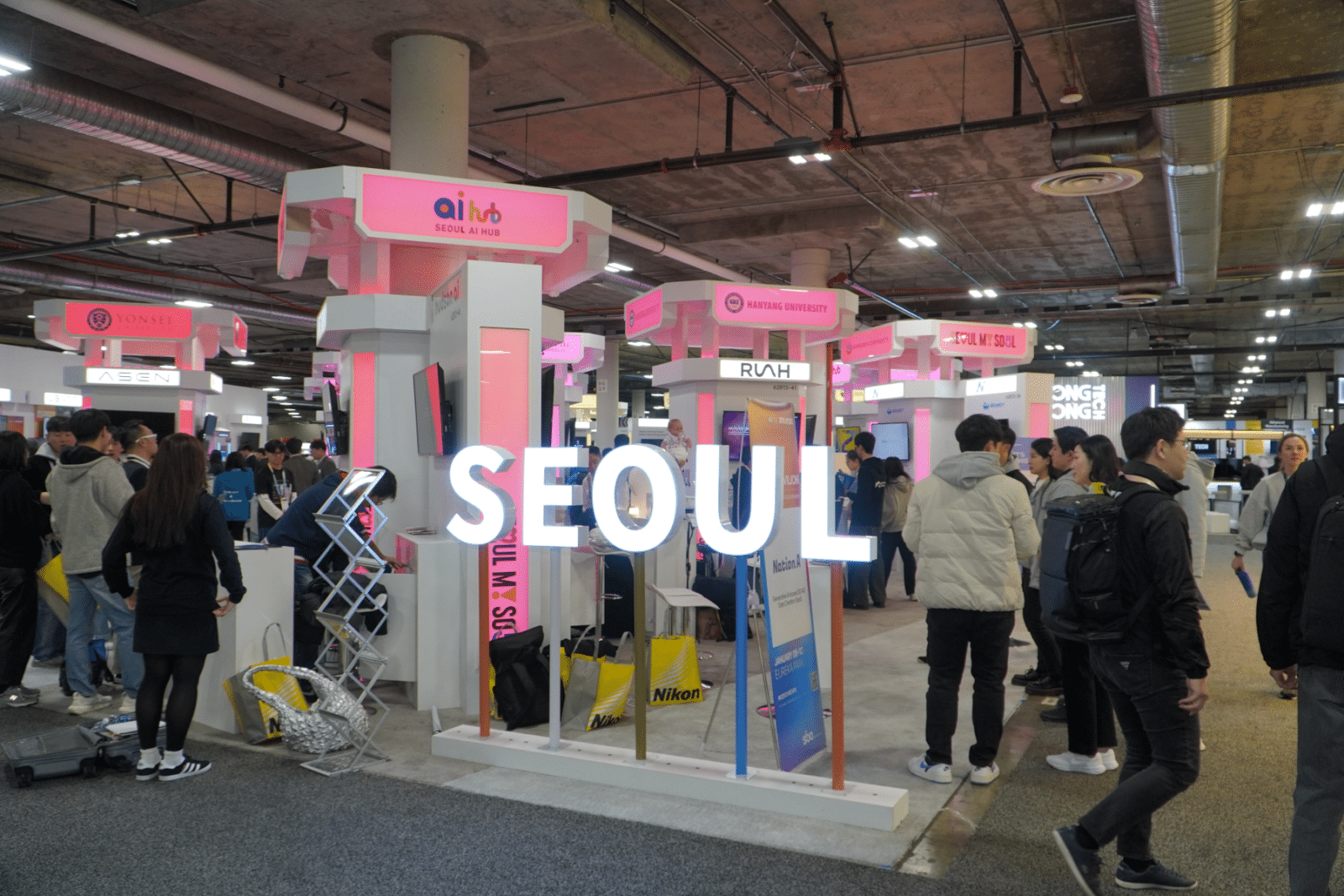
In January 2024 we spent the week at the Seoul Pavilion at CES and wrote up the companies exhibiting there one by one, 23 of them. Most were early-stage, most had never been covered in English, and a fair number had nothing beyond a prototype on a small table.
Two years is long enough to tell the difference between a good CES booth and a real company. So we went back through the list to find out what actually happened. Below is what we found, grouped by where each company ended up rather than by what it promised at the time.
The short version: two of the 23 are now preparing to list on the Korean market, one has been absorbed by a larger company, and several have taken money from the biggest names in Korean tech, Naver, Kakao and Korean Air among them. A larger group has gone publicly quiet, which is its own kind of answer.
Heading for the stock market
PABLO AIR, from a failed IPO review to Korean Air money
When we saw PABLO AIR at the Seoul Pavilion, it was showing drone swarm formations. It is now the clearest success story of the cohort, and it did not travel in a straight line.
The company failed the technical review on its first attempt to go public in 2024. It then merged with the defence components manufacturer VOLK in September 2025, and in January 2026 closed a pre-IPO round of 107.5 billion won, about 75 million dollars, with Korean Air, LIG Nex1 and IBK Capital taking part. Its joint swarm-drone aircraft inspection system, InspecX, won a CES 2026 Innovation Award. The listing is targeted for the first half of 2026.
The interesting part is not the money, it is the sequence. A rejected IPO review in 2024 did not end the company; it pushed it into a merger and a strategic investor. That is a fairly Korean path, and one worth remembering before writing off a startup that misses its first window.
Meissa, from forest monitoring to construction sites
We covered Meissa Planet for forestView, its AI for forest monitoring. The forest product was the shop window; the business turned out to be construction.
Founded at Seoul National University in 2017, Meissa now sells drone and satellite spatial analysis to Korea’s largest builders, including Hyundai Engineering & Construction, Daewoo E&C, GS E&C and DL E&C. It raised a 7.5 million dollar Series C in November 2024, then a pre-IPO round of about 6.8 million dollars in December 2025, bringing cumulative funding to roughly 23.9 million dollars, or 35 billion won. Kiwoom Securities is underwriting a listing targeted for the second half of 2026.
Acquired
Bering Lab, bought by Intersphere Korea
Bering Lab was at the pavilion with AI translation built specifically for legal and patent text, a narrow niche and a defensible one.
It raised 3 billion won, around 2.3 million dollars, in a pre-A round led by SBVA (formerly SoftBank Ventures Asia), after earlier backing from Naver. It reached more than 300 clients, including over 140 law firms and corporate legal teams. On 1 October 2025 it was merged into Intersphere Korea.
For a four-year-old company in a specialist vertical, an acquisition is a reasonable outcome rather than a failure. It is also the fastest exit in the cohort.
Still independent, now backed by the giants
Enhans, and a cheque from Naver Ventures
We wrote about Enhans and its AI for commerce in January 2024. Founded in 2021, it had already closed a 7.5 billion won Series A led by Hyundai Venture Investment, L&S Venture Capital and KDB Capital.
In April 2026 it announced a strategic investment from Naver Ventures, taking total funding to about 10.1 million dollars. It now reports more than 30 enterprise clients, Samsung Electronics among them, and operations in over 50 countries, with 11 patents filed in Korea and the United States.
Phantomics, validated by GE and Siemens
Phantomics showed us AI analysis of cardiac MRI, and had just taken a CES 2024 Innovation Award. Medical AI usually lives or dies on whether hospitals and equipment makers will touch it.
In 2025 the company signed agreements with GE HealthCare Korea and, separately, with Siemens Healthineers Korea, both aimed at putting its cardiac MRI analysis into clinical use. Two of the three largest medical imaging manufacturers in the world, in the same year. For a company founded in 2019, that is a stronger signal than most funding rounds.
Draph, awards but no disclosed round
Draph automates commercial product photography through its Draph Art platform. Founded in 2022, it was selected for the Ministry of SMEs and Startups Super Gap Startup 1000+ programme in 2024, and won the Grand Prize at the CONTENT NEXT WAVE Demo Day in 2025.
We found no disclosed funding round since. Government programme selection in Korea is meaningful, it comes with money and procurement access, but it is not the same as a priced round.
Quiet, which is not the same as gone
Several companies we covered have made no public announcement we could find since early 2024. That does not mean they have shut down. Korean startups frequently operate for years on government programmes and revenue without issuing English-language press releases, and absence from Western databases proves very little.
TJLABS, whose indoor positioning technology we covered, is backed by Kakao Mobility and Kakao Ventures alongside Kimgisa Lab, Laguna Investment and SUPERSTART. Strong investors, no news since. Luxrobo, the oldest company on the list at ten years, has raised about 4.86 million dollars across three rounds from investors including Kakao Investments and Hanwha, and has been quiet publicly as well.
The others we covered, and where we could not establish a clear outcome: SOLIVIS (solid-state batteries), B4PLAY (gaming data), Reziena (at-home HIFU), FitSole (AI insoles), UNIUNI (AIoT security), Toonsquare and Onoma AI (AI webtoons), SOLIVE VENTURES (educational toys), Romansive (COZA SLEEP), Biot Korea (medical robotics), QSIMPLUS (quantum communications), Mirroroid (smart mirrors), Wemeet Mobility (Roouty, last-mile delivery), Hudson AI (AI dubbing) and Orientum (quantum computing for finance).
What the cohort says about Korea
Three things stand out from following 23 companies over two years.
The winners did not win with the product they showed us. Meissa exhibited forest monitoring and built a construction business. PABLO AIR showed drone swarms and got to a pre-IPO round through a defence merger. Enhans pitched AI shopping and sells an enterprise AI platform. The CES booth was a door, not a destination.
Strategic and corporate money matters more than venture money here. Korean Air, Naver, Kakao, LIG Nex1, plus government programmes like Super Gap Startup 1000+. The companies that advanced did so with an industrial partner or a state programme attached, not purely on venture capital.
Korea’s presence at CES is not a fluke. Korean companies took roughly 60 percent of CES 2026 Innovation Awards. The Seoul Pavilion cohort we followed is a small sample of a national export machine that is still accelerating.
How we did this
We started from our own 23 articles published between 14 and 27 January 2024, then searched for each company’s public record since: funding announcements, corporate filings, partnership news and Korean and international trade press. Where we found nothing, we say so rather than guess. Figures are as reported by the sources at the time of publication; won-to-dollar conversions follow the rates given in those reports.
If you are one of the companies on this list and our picture is out of date, or wrong, tell us and we will correct it and note the correction on the page.