
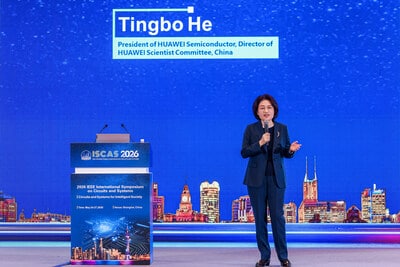
Semiconductor development is entering a new era. HUAWEI has introduced the Tau Scaling Law, a groundbreaking concept poised to succeed Moore’s Law. Announced at the 2026 IEEE International Symposium on Circuits and Systems, this innovation could reshape the future of chip technology and performance.
Tau Scaling Law: A New Paradigm Beyond Traditional Moore’s Law
For decades, Moore’s Law has guided the semiconductor industry. However, shrinking transistors is becoming increasingly challenging. The Tau Scaling Law shifts the focus from geometric scaling to time scaling. Instead of only making transistors smaller, this approach minimizes signal propagation delay and system execution time. Key advantages include:
- Boosted performance
- Improved energy efficiency
- Increased transistor density
This new rule aims to revitalize chip evolution as traditional gains plateau.
HUAWEI’s Innovations: LogicFolding and Multi-Level Optimization
HUAWEI is spearheading several technologies under the Tau framework. Notably, LogicFolding restructures chip layouts to shorten critical signal paths, reducing resistive and capacitive loads. The company is also implementing a multi-level optimization strategy across:
- Devices – lowering physical-layer delays
- Circuits – optimizing signal flow and density
- Chips – enhancing parallelism with improved architecture
- Systems – enabling unified memory addressing using UnifiedBus protocol
Over the past six years, HUAWEI has mass-produced 381 chips using these innovations, serving smartphones, AI computing, and other industries.
Future Impact: Kirin Processors and Collaboration in Chipmaking
Looking ahead, the upcoming Kirin processors—set for release in fall 2026—will be the first to feature the LogicFolding architecture. This advancement promises significant leaps in chip performance. Moreover, HUAWEI projects its chips could match the transistor densities of advanced 14-angstrom (1.4 nm) technologies by 2031. Notably, collaboration remains crucial. HUAWEI emphasizes that breakthroughs in semiconductor technology require collective effort across the industry.
In summary, HUAWEI’s Tau Scaling Law marks a pivotal shift for the semiconductor world. By replacing geometric scaling with time scaling and introducing LogicFolding, the company is paving the way for faster, more efficient chips. As high-end processors adopt these innovations, industry-wide cooperation will be essential for meeting tomorrow’s computing demands.
Don’t miss our latest Startup News: Bluon ServiceTitan Integration Delivers Powerful Boost to HVAC Pros